

“I have a home loan. I’m also investing ₹40,000 every month through SIPs. Should I stop my SIP, finish my home loan first, and then restart investing?”
One of our Kodeeswari clients asked us this recently.
It’s a question many people silently struggle with.
After all, becoming debt-free feels like the responsible thing to do. If you can close your home loan sooner, why continue investing?
But personal finance isn’t about choosing what feels right. It’s about understanding what each decision costs you—not just today, but years from now.
So instead of giving an opinion, we did what every financial planner should do.
We opened a calculator.
The Situation
Here’s what her finances looked like:
· Outstanding Home Loan: Rs. 12.63 lakh
· Interest Rate: 9.99% p.a.
· Current EMI: Rs. 30,000
· Remaining Tenure: 52 months
· Monthly SIP: Rs. 40,000
Her question was simple.
“Where should my next ₹40,000 go? Towards my home loan or towards building my wealth?”
To answer that, we explored three possible approaches.
Option 1: Stop the SIP and Finish the Home Loan
This is the advice many people receive.
“Finish your loan first. You can always invest later.”
So let’s see what happens.
If she stopped her ₹40,000 SIP and used that money to repay the loan, her monthly EMI would increase from ₹30,000 to ₹70,000.
The Result
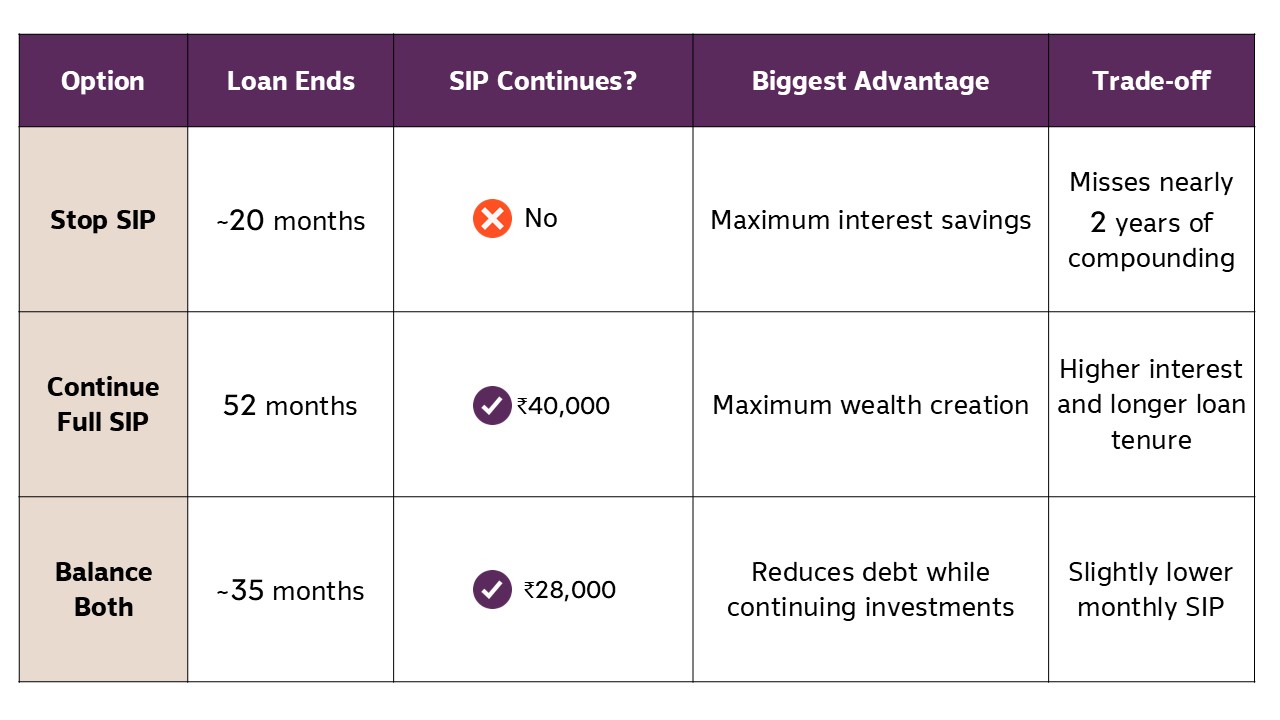
· ✅ Home loan closes in around 20 months instead of 52 months.
· ✅ Nearly 32 months of loan tenure saved.
· ✅ Significant interest savings.
On paper, this looks like the perfect decision.
But here’s the question most people never ask.
What happens to your investments?
For almost two years, she wouldn’t invest a single rupee.
If markets performed well during that period, those opportunities would be gone forever.
You can repay a loan later.
You cannot buy yesterday’s market.
That invisible cost is called opportunity cost, and it’s one of the biggest mistakes investors overlook.
Option 2: Continue Investing and Ignore the Loan
Now let’s look at the other extreme.
She continues investing the full Rs 40,000 SIP every month while paying only the regular EMI.
The Result
· ✅ Investments continue without interruption.
· ✅ Every SIP gets more time to benefit from compounding.
However…
· ❌ The home loan continues for the full 52 months.
· ❌ More interest is paid over time.
· ❌ The EMI burden remains for another four years.
This option is excellent for long-term investing, but it also means carrying debt longer than necessary.
Option 3: The Middle Ground
Here’s the option most people never consider.
Instead of choosing between investing and loan repayment, why not make your money do both?
Rather than investing the entire ₹40,000 every month:
· Continue investing Rs. 28,000
· Add Rs. 12,000 to the EMI
Her monthly EMI became Rs. 42,000.
The Result
· ✅ Loan tenure reduced from 52 months to around 35 months.
· ✅ Home loan closes 17 months earlier.
· ✅ Investments continue every month.
· ✅ Interest burden reduces.
· ✅ She doesn’t lose the discipline of investing.
This wasn’t the fastest way to close the loan.
It also wasn’t the fastest way to build wealth.
But it balanced both goals beautifully.
A Simple Comparison
The Bigger Lesson
Most people calculate only one number.
“How much interest will I save?”
But very few ask another important question.
“How much wealth could I lose by stopping my investments?”
Good financial planning isn’t just about reducing debt.
It’s about making sure today’s decisions don’t compromise tomorrow’s wealth.
That’s why there is no one-size-fits-all answer.
The right decision depends on:
· Your home loan interest rate
· Your income stability
· Your emergency fund
· Your financial goals
· Your investment horizon
· Your comfort with debt
Personal finance is called personal for a reason.
The Kodeeswari Perspective
At Kodeeswari, we don’t believe financial planning is about choosing between paying off debt and building wealth.
We believe every rupee should have a purpose.
Sometimes, that purpose is reducing your financial burden.
Sometimes, it’s creating long-term wealth.
And very often, it’s doing both.
That’s why we don’t recommend the same strategy to everyone.
A home loan at 8% is different from one at 10%.
A young professional has different priorities from someone planning for retirement.
Your income, family responsibilities, goals and investments all matter.
The right answer isn’t what worked for someone else.
It’s what works for your financial life.
Before stopping your SIP, ask yourself:
· Am I trying to save interest, or am I sacrificing years of compounding?
· Can I increase my EMI without completely stopping my investments?
· Will this decision still make sense five or ten years from now?
Sometimes, one simple calculation today can save years of financial regret tomorrow.
Need Help Deciding?