

For generations, women have been taught to "play safe" with money. But is keeping your money safe the same as helping it grow? This blog explores how traditional saving habits, inflation, and confidence gaps can quietly impact long-term wealth—and why smart investing is the next step toward true financial independence. Read on to discover how to turn careful saving into lasting wealth.
“Don’t touch that money.”
It’s probably one of the first financial lessons many Indian women ever learned.
Not from a finance book.
Not in school.
Not from a bank.
But around the dining table.
“Keep some cash aside.”
“Don’t take risks.”
“Fixed Deposit is the safest.”
“Gold will always save you.”
Over the years, these stopped being advice. They became beliefs.
And somewhere along the way, playing safe quietly became every woman’s financial plan.
But here’s a question worth asking:
Is your money really safe if it never grows?
The Day Priya Realised She Had Been “Careful” For 20 Years
Priya (name changed), a 46-year-old school teacher, walked into our office carrying three neatly organised folders.
Every investment she had ever made was labelled.
Every FD receipt was laminated.
Every maturity date was highlighted.
She smiled and said,
“I’ve never taken a financial risk in my life.”
Honestly, it sounded impressive.
Until we looked at the numbers.
Over twenty years, Priya had managed to save almost ₹22 lakh.
Not a small achievement.
She had sacrificed vacations, postponed buying things she liked, and even skipped personal expenses to build that corpus.
Then we asked one simple question.
“What do you want this money to do for you over the next twenty years?”
Silence.
She had spent twenty years protecting her money.
She had never thought about helping it grow.
That is when she realised something many women don’t.
Being careful with money and making money work for you are two completely different skills.
Safety Feels Comfortable. But Comfort Can Be Expensive.
Imagine buying a refrigerator and never switching it on because you don’t want the electricity bill.
It stays new.
It never gets damaged.
But it also never does what it was meant to do.
Money works the same way.
Keeping every rupee in places where it barely grows may feel safe.
But over time, inflation quietly eats away its purchasing power.
Today, ₹1,000 doesn’t buy what it did ten years ago.
What will ₹1,000 buy twenty years from now?
That’s the real risk.
Not investing.
Not planning.
Not growing.
The Invisible Thief Nobody Talks About
Most people think losing money happens in one dramatic event.
A stock market crash.
A bad investment.
A fraud.
But for many families, wealth disappears much more quietly.
It disappears one basis point at a time.
If inflation averages around 6% a year and your post-tax return is close to that—or lower—your money may not meaningfully increase your purchasing power over the long term.
You won’t notice it next year.
You probably won’t notice it in five years.
But after twenty years, the lifestyle your savings can support may be very different from what you expected.
That’s why economists often call inflation the “silent thief.”
It steals without making any noise.
Women Save Exceptionally Well. Why Don’t They Invest With The Same Confidence?
Here’s something fascinating.
Studies across the world consistently show that women are disciplined with money.
They budget better.
They panic less during market volatility.
They stay invested longer.
Yet many women hesitate to begin investing because they feel they “don’t know enough.”
Research from organizations such as the Boston Consulting Group (BCG) and industry reports on women investors has repeatedly highlighted that women often underestimate their financial knowledge despite demonstrating strong long-term investing behaviour.
The problem isn’t capability.
It’s confidence.
What Playing Safe Actually Costs
Let’s take two sisters.
Both save ₹10,000 every month for twenty years.
One chooses only savings accounts and fixed deposits.
The other builds a diversified long-term investment portfolio suited to her goals and risk tolerance.
Neither spends recklessly.
Neither gambles.
Both are responsible.
The only difference is that one allows her money the opportunity to grow over time.
The gap at the end of twenty years can be enormous.
Not because one earned a much higher salary.
Not because one got lucky.
Simply because one understood the difference between saving and wealth creation.
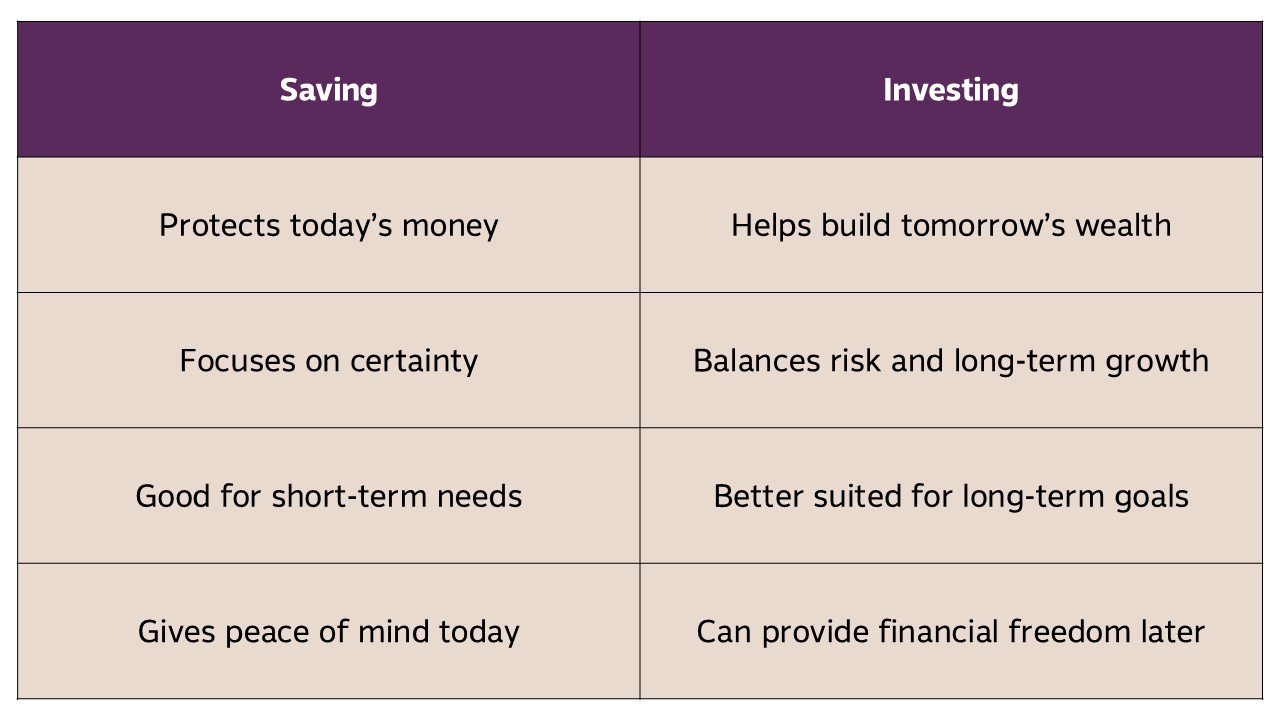
Saving is important.
But saving alone rarely builds wealth.
Think About Every Woman You Know
Think of your mother.
She probably saved the best saree for someone else’s wedding.
She kept cash hidden in the kitchen for emergencies.
She reused containers.
Negotiated with vegetable vendors.
Turned leftovers into tomorrow’s lunch.
She knew the value of every rupee.
Now imagine if the same discipline had been combined with the power of long-term investing.
How different might retirement have looked?
How much more independent could she have been?
The lesson isn’t that our mothers were wrong.
They did the best they could with the information available to them.
Our responsibility is to build on that foundation—not remain limited by it.
Playing Safe Isn’t Wrong. Stopping There Is.
You don’t have to become an expert in the stock market.
You don’t have to track business news every day.
You don’t have to predict where markets will go next.
Financial planning isn’t about taking reckless risks.
It’s about understanding which risks are worth taking—and which ones quietly cost you more than you realise.
Sometimes, the biggest financial risk isn’t investing.
It’s assuming that doing nothing is the safest choice.
Before You Close This Page…
Ask yourself these five questions:
· If I stop working tomorrow, how long can my savings support me?
· Is my money growing faster than inflation?
· Am I saving because I’m afraid, or because I have a plan?
· If my daughter follows my financial habits exactly, will I be proud?
· Am I protecting my money—or am I helping it build the life I truly want?
Sometimes, financial freedom doesn’t begin with opening a new investment account.
It begins with questioning an old belief.
Maybe it’s time to replace “Play safe.”
With something far more powerful:
“Play smart.”
Start playing smart with Kodeeswari today! Enroll now!